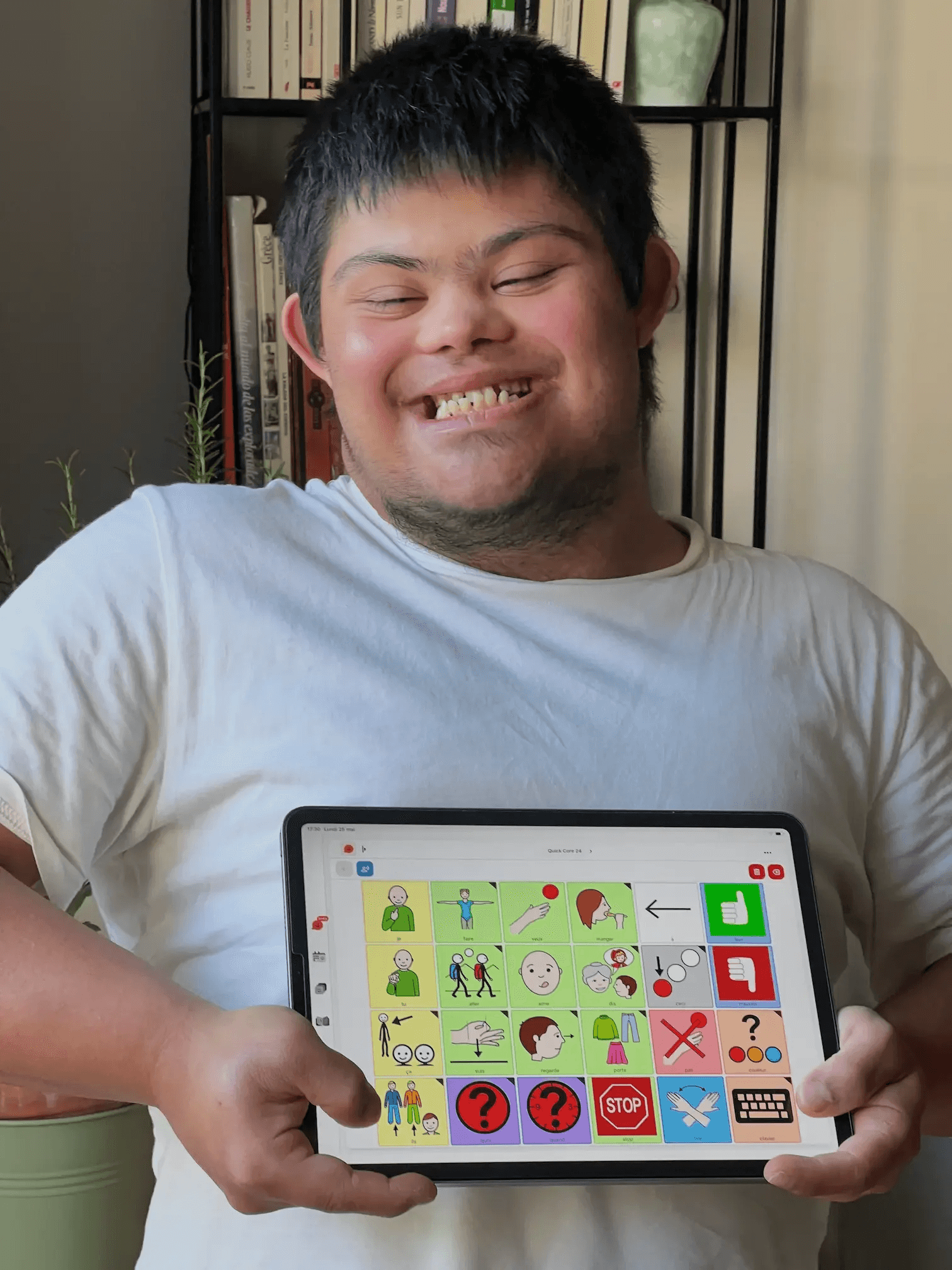

Pictalk Buddy integrates AAC
Pictalk AAC has existed for five years. Nearly 10,000 people use it every month worldwide to communicate, express themselves, and be heard.
Five years is a long time in the world of applications. Phones have become more powerful, tablets more accessible, AAC research has advanced considerably. What was difficult to implement in 2020 is now possible. What was acceptable as a user experience is no longer so.
Communication and autonomy are the two pillars of Pictalk's mission. They cannot be separated: one cannot truly be autonomous without being able to express oneself, and speech only makes sense if it is part of a structured and clear life. We have known this from the start. But our two applications lived separately.
It was time to change that and to give our users the best that AAC can offer today.
Download
Download the Pictalk Buddy application from the AppStore or PlayStore:


What actually changes
Ready-to-use vocabularies

You no longer have to build everything from scratch. Extensive and progressive default vocabularies are integrated, adaptable to each profile and age. Moreover, they are built around the most frequent everyday words, which alone represent the majority of what is expressed in a day. A real time saver for families as well as professionals, who can focus on learning rather than configuration.
The vocabularies come from the Open AAC database.
Redesigned ergonomics

Rearranging pictograms is now done by drag-and-drop. The grid mode facilitates muscle memory, essential for regular users. Aided language displays (ALDs) are now printable directly from the app. Organizing your vocabulary has never been so simple.
A robust application

Sentence construction becomes smoother and more natural.
Labels automatically adapt to the subject and tense of the sentence. The app learns from your corrections and your vocabulary to become increasingly personalized. Multiple levels of autocorrection and expansion are available, with real-time next word suggestion, like on a keyboard. The goal: to access a complete and complex language more easily.
Your sentence history

Building a sentence takes time. Rebuilding it every time is an energy no one should have to spend. The history allows you to instantly find previously spoken sentences and mark them as favorites for recurring situations: at the doctor’s, at the table, at school.
Voices of unprecedented quality

The voice is not a detail. It is what the interlocutor hears first. A robotic voice or one unsuitable for the age creates distance where communication should create connection.
Thanks to ElevenLabs, the voices available in Pictalk reach a level of unprecedented naturalness. And because it is unacceptable to equip a little girl with a grandfather’s voice, or a teenager with a voice from beyond the grave, we are working to offer a choice of voices adapted to each profile: age, gender, accent.
Coming soon...
We are working on several features that will deeply transform the AAC experience in Pictalk Buddy.
AI will be able to automatically generate pictograms adapted to the person’s context, drawing from their schedule and life diary. No need to anticipate everything: relevant vocabulary will be there at the right time.
Autocorrection and suggestions will rely on this same context to become finer and more personalized.
A progress tracking will allow visualization of vocabulary evolution, completed tasks, sentence complexity. Valuable data for families and professionals who support daily.
To facilitate the creation of aided language displays, a design aid for ALDs will be integrated directly into the app.
Finally, a feature will gradually suggest which words to reveal or hide in the grid, based on mastered vocabulary. The goal: preserve the efficiency of muscle memory while expanding language at the right pace, without overloading.
The question of funding
For families, access remains pay-what-you-want. Everyone can access speech, even for free.
Synchronizing the vocabulary of a person supported across multiple devices, among several educators, while leaving room for personalization: this is one of the most time-consuming challenges in daily structure work. Pictalk Buddy finally allows maintaining a common and evolving base, while allowing individual adjustments.
Content management is done remotely from an administrator account, without having to intervene on each device. And, because communication and autonomy cannot be separated, supported persons benefit from the entire Pictalk suite in a single tool.
These features are included in Pictalk Pro membership, which funds the association’s development and sustainability.
Pictalk AAC in all this?
The two applications will continue to coexist. Pictalk AAC version 1 remains available until the end of 2026, allowing a smooth transition.
From then on, the old version will be gradually phased out and we will support users in migrating to the new version.
Because Pablo deserves this. And everyone like him deserves to be heard too