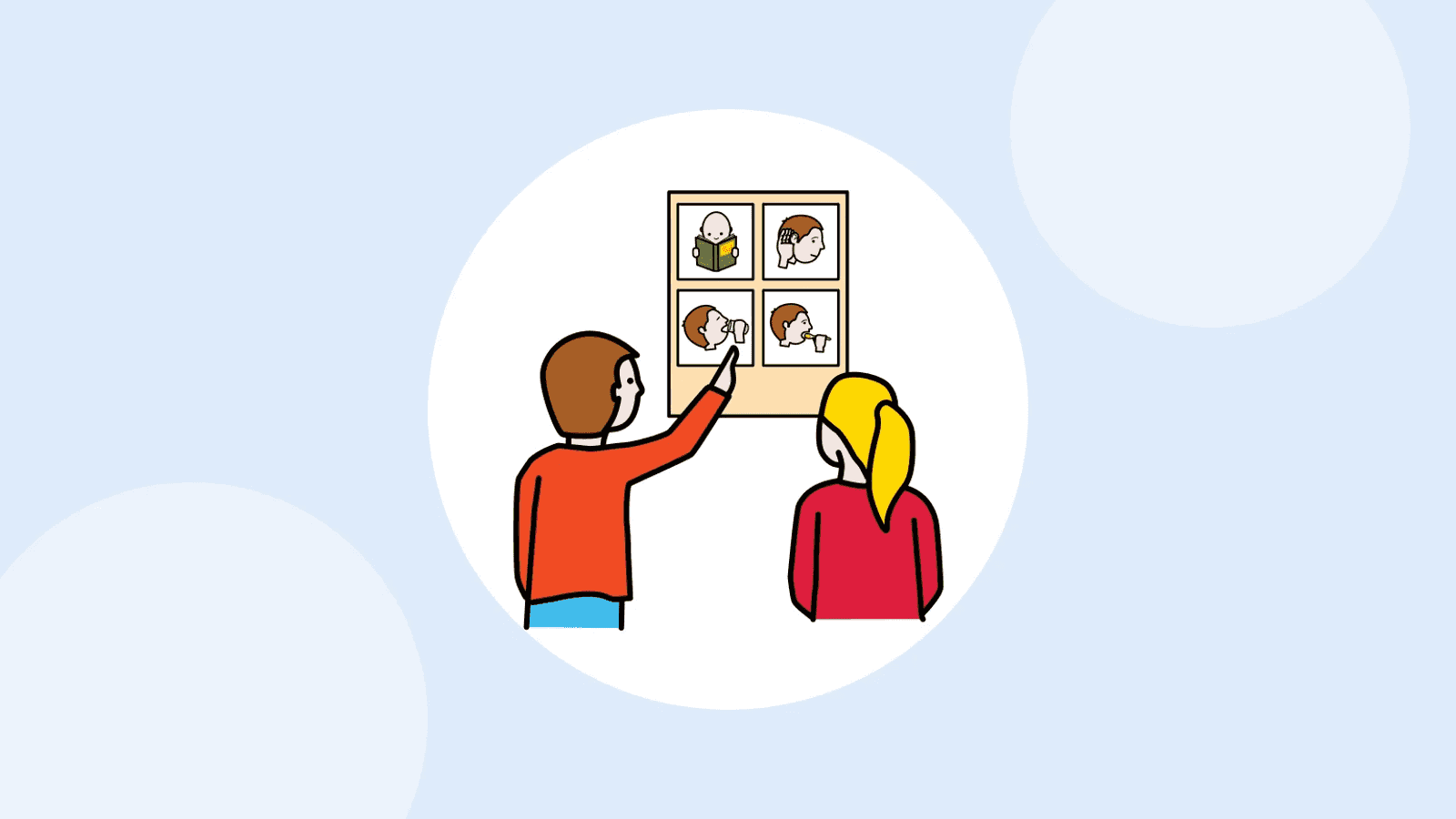

How can you help someone use their AAC tool? By using it yourself in front of them, every day: you talk while touching their symbols (model), you give them time (wait) and you react to each of their attempts (respond). It is one of the best-supported strategies in AAC, and it can be learnt in a few hours.
 ModelShow the words on their tool as you talk
 Wait5 to 10 seconds, without asking anything
 RespondTo every attempt, adding to it
What is modelling?
Modelling means ‘speaking AAC’ in front of the person. During an activity they enjoy, you say your sentence out loud and touch the key words of that sentence on their tablet, phone or paper board. It is also called aided language stimulation or aided language input. The principle: what the person sees and hears should look like what we expect them to produce with their symbols (Beukelman and Light, 2020).
Modelling is not making someone repeat. You don’t ask for anything: no ‘Show me MORE’, no ‘Where is DRINK?’. You show how the tool is used.

Why is it essential?
A child learning to talk hears more than a million words before saying their first (Hart and Risley, 1995). A child who communicates with symbols almost never sees anyone use their symbols: even trained partners often model less than 10% of what they say (Romski and Sevcik, 2003). We ask them to express themselves in a language they have almost never seen spoken.
Several meta-analyses show large effects of modelling on understanding, and even more on expression (Allen et al., 2017; Biggs, Carter and Gilson, 2018; O’Neill, Light and Pope, 2018). These effects are found in toddlers as well as adults, in autism, cerebral palsy, Down syndrome and learning disability, whether the model is a parent, a classmate, a teaching assistant or a speech and language therapist, with a paper board as with an app.
Modelling is not always enough: toddlers learnt more words when they were also invited to use the symbols (Romski et al., 2010). Hence the three steps in this guide.
How to start this week?
- Keep the tool within reach during meals, bath time, play and journeys. For messy activities, have a laminated version or a protective case.
- Choose one to five target words for the week, for example MORE, ALL DONE, HELP ME, LOOK, NOT, and show them at every natural opportunity (this is ‘focused stimulation’). Mix very frequent little words with personal words that motivate (their sister’s name, their favourite cartoon): core vocabulary is necessary, but never enough (Laubscher and Light, 2018). See Which words to put in the tool.
- Model during favourite moments: games, meals, bath time, cartoons, outings. Start with two or three moments a day, then build up.
- Talk normally, touch one or two key words. ‘Oh, do you want more water?’ while touching MORE; ‘Let’s go and play outside’ while touching GO then PLAY. Keep a full sentence in speech, never telegraphic style (‘you drink water’), even if the screen only shows two of the words (Fey, 2008).
- Learn where the words are yourself. Adults model little mainly because they are slow to find the words. With a vocabulary where words never move, you learn the positions at the same time as the person (see Organising the grid).
- Vary the messages: not just requesting, but also commenting (‘that’s funny’), refusing (‘not that’), asking (‘what’s that?’). See Beyond requests.
Waiting: how long?
Speech runs at 150 to 250 words per minute; aided communication is typically 15 to 25 times slower. Without support, the same pattern is almost always seen: the partner takes most of the turns, chooses the topics and asks mostly closed questions; the person answers, but rarely starts the conversation.
After a question, an offer or a model, look at the person with friendly expectation and wait 5 to 10 seconds without saying anything. Wait longer if they have significant motor difficulties or a cognitive impairment, or with a new routine. Ten seconds is a long time: count in your head ‘one elephant, two elephants…’. Most adults prompt again, rephrase or answer for the person after two or three seconds. Yet this pause gives them time to understand and find the word, and shows that it is their turn.
Don’t finish the message too soon. The person touches EAT and you exclaim ‘Ah, you’re hungry!’, when they may have wanted to say ‘the dog is eating’. Wait after the first symbol: the rest often follows. Some people like you to guess, as long as you check; others hate being interrupted. Ask them, and write it down on their ‘How to talk to me’ card.
Respond to every attempt, then add to it
Respond straight away to whatever the person expresses, whatever the form: a look, a gesture, a sound, a symbol. If they touch a symbol ‘by accident’, respond as if it were deliberate.
- Add one word, on their tool. They touch WANT BALL? ‘You want the red ball?’ while touching RED. They touch DOG? ‘Yes, the dog is running’ while touching RUN.
- Show the right symbol when they make a mistake, instead of correcting only in speech, a common reflex in partners (Smith and Grove, 2003).
- Check what you have understood: ‘Do you mean you want to go to the park?’.
- Ask real questions, whose answer you don’t know, rather than test questions (‘what’s that?’ in front of a cat). Closed questions are still useful, especially when the person is tired: end them with ‘yes or no?’ while showing a nod.
If nothing comes after the wait, model a possible answer on their tool, without requiring them to repeat it, then move on.
How to create opportunities to communicate?
When everything is anticipated (the glass filled before they are thirsty, the toy within reach), there are few reasons left to communicate. Set up small situations that make them want to talk:
- give a very small portion, so they ask for MORE;
- put the favourite toy in sight, but out of reach;
- close the jar a little too tightly, so they ask for HELP ME or OPEN;
- ‘forget’ the spoon or hand over the wrong object, so they can say NOT THAT;
- stop the song halfway, then wait;
- offer a choice between two things, one of which they don’t like.
Two conditions: the word they need is on their tool, and the game stays light. Stop before frustration sets in.
Create an opportunity, wait, respond: this is the PoWR cycle (Douglas, McNaughton and Light, 2013). Practised regularly, it changes the interaction profoundly.
Inviting, prompting: in which order?
When the person has often seen a word, you can invite them to use it, then prompt if needed, gradually withdrawing support. Two ways of doing it:
- From least to most support (wait, point to the tool, then model the word): for rather passive people, to avoid them depending on prompts.
- From most to least support (model, point, then wait): for impulsive people, difficult skills, and when replacing a behaviour that challenges with a message (see Behaviours that challenge).
In both cases, never take the person’s hand to make them touch the symbols.
How to adapt to the person?
| Profile | Guidance |
|---|---|
| Toddlers and beginners | Respond to every signal as if it were intentional, name it, then show a more conventional form. A communication dictionary shared between home and nursery helps everyone read the same gestures. |
| After a brain injury | Don’t rush the person or pile on suggestions while they are composing their message. |
| Dementia | Remove distractions, use short sentences, ask closed questions. Speaking more slowly did not help in the studies reported (Small et al., 2003). |
| Aphasia | Be wary of automatic nodding: many people nod to keep their place in the conversation without having understood. See AAC for adults. |
Training partners: quicker than you think
The more people model (parents, brothers and sisters, teaching assistants, support workers), the more the person sees their tool being used. And these strategies are quick to learn. Less than five hours of training is often enough to change the way people interact for the long term (Kent-Walsh and Binger, 2013), and ‘just in time’ training sessions of 15 to 20 minutes already have a measurable effect (Holyfield et al., 2018). After a short video, classmates read their peers’ signals correctly 86% of the time, compared with 33% before.
The ImPAACT programme (Kent-Walsh and Binger, 2013) trains five skills: modelling, pausing to wait, asking open questions, prompting then fading support, responding to every attempt by adding to it. The method that works: describe the strategy, demonstrate it, practise with feedback, then apply it in real life. Parents prefer short, repeated sessions of about an hour (Meder and Wegner, 2015).
The memory aid ‘LAF, Don’t CRY’ (McNaughton and Vostal, 2010): listen, ask, focus on the person; don’t criticise, rush or make it all about yourself.
Dos and don’ts
| Do | Don’t |
|---|---|
| Keep the tool available all day, in every room | Wait until the person ‘is ready’: there are no prerequisites (see Myths about AAC) |
| Model during activities the person enjoys | Turn modelling into a quiz (‘Show me…’, ‘Where is…?’) |
| Speak in full sentences and touch the key words | Speak in telegraphic style because the screen only shows two words |
| Choose a few target words a week and show them often | Only model requests (‘I want’) |
| Wait 5 to 10 seconds after modelling | Finish the message for them from the first symbol |
| Respond to every attempt, then add one word | Take the person’s hand to make them touch the symbols |
| Show the right symbol when the person has made a mistake | Keep moving words or reorganising the board |
| Create small opportunities to communicate, without frustration | Give up after a few days: learning is counted in months |
Printable materials are available on the resources page.
Frequently asked questions
What if the person doesn’t look when I model?
That’s common at first. Keep going: many people watch out of the corner of their eye. Place the tool near your face or near the object of the activity.
Should I model on their tool or on mine?
Preferably on theirs, so your movements match theirs. A duplicate (paper board or the app on your phone) works if the words are in exactly the same positions; in Buddy, the vocabulary syncs between devices.
How long before you see progress?
There is no guaranteed timescale. A child hears their language for more than a year before speaking: a person learning AAC also needs a long immersion in aided language, which is counted in months.
Pictalk Buddy brings together AAC boards, a visual schedule, guided sequences and notebooks, with the same symbols, on Android, iOS, the web and the watch. A pay-what-you-want app, developed by a non-profit association. Discover Buddy
Sources
- Beukelman, D. R., & Light, J. C., 2020, Augmentative & Alternative Communication (5th ed.), Paul H. Brookes, chapters 3, 4, 10, 11 and 12.
- Studies cited from Beukelman & Light (2020): Hart & Risley (1995); Romski & Sevcik (2003); Romski et al. (2010); Allen et al. (2017); Biggs, Carter & Gilson (2018); O’Neill, Light & Pope (2018); Fey (2008); Laubscher & Light (2018); Smith & Grove (2003); Douglas, McNaughton & Light (2013, PoWR); Kent-Walsh & Binger (2013, ImPAACT); Holyfield et al. (2018); Meder & Wegner (2015); McNaughton & Vostal (2010); Small et al. (2003).