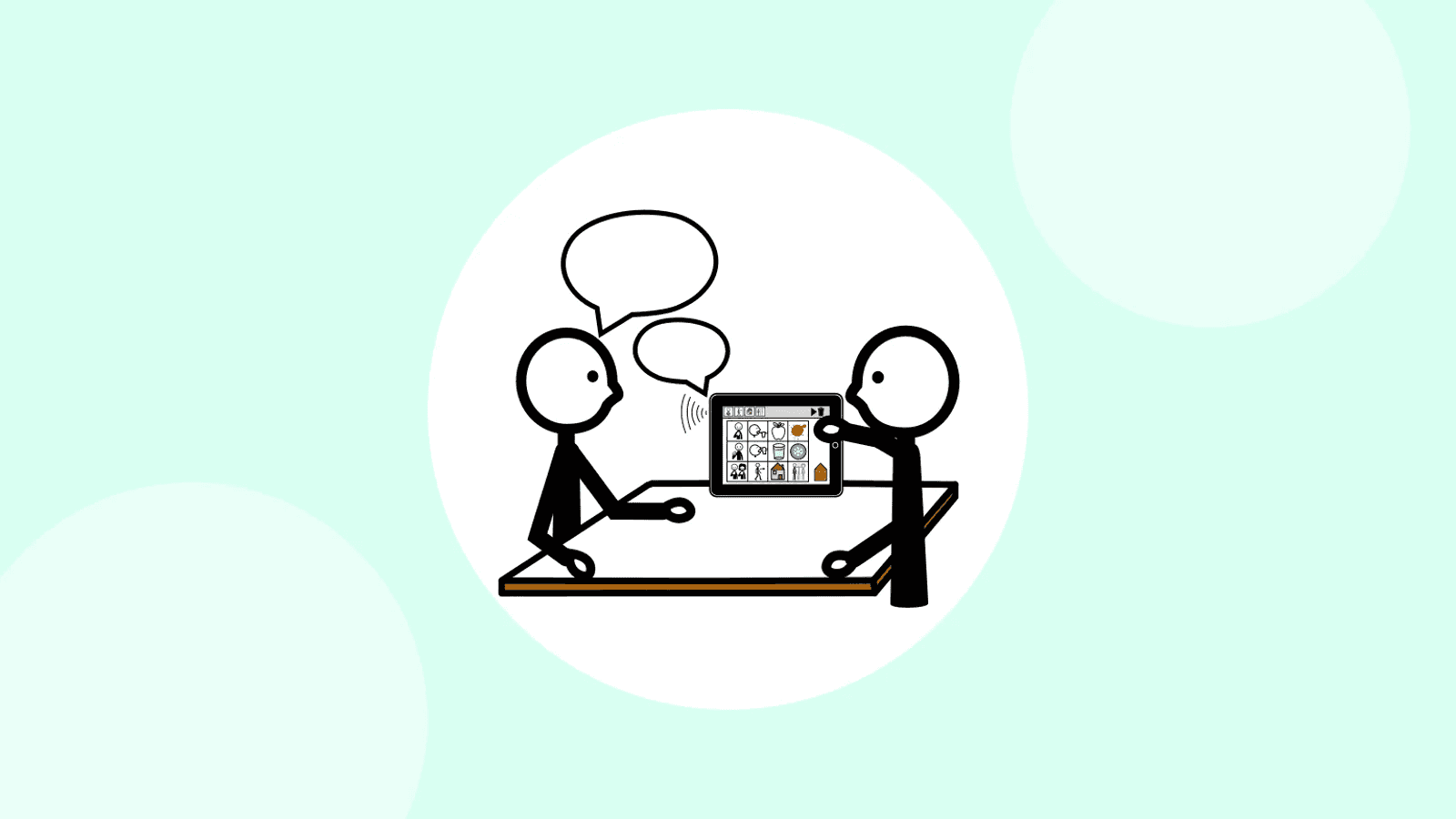

Does your child only use their tablet to ask for things? It is a common stage, but requesting is only one of the reasons we communicate: we also talk to share news, make people laugh, say hello, protest or organise our thoughts. The tool must cover all these functions, with words to put together and ready-made phrases.
Why do we communicate?
Janice Light (1988) distinguishes four main reasons to communicate, to which a fifth is often added, inner dialogue. Each asks something different of the tool.
| Function | Examples | What the tool needs |
|---|---|---|
| Needs and wants | A drink, going to the toilet, asking for help, changing position | Quick, precise messages, reachable in one or two moves |
| Passing on information | Telling about one’s day, answering in class, describing a symptom | Lots of words, the ability to combine them, and eventually writing |
| Social closeness | Greeting a friend, teasing, comforting, joking, saying ‘I love you’ | Variety, emotions, humour; speed matters less |
| Politeness and social etiquette | Please, thank you, have a nice day, sorry | Ready-made phrases that can be used independently and quickly |
| Inner dialogue | Making a list, keeping a diary, planning one’s day | Schedules, notebooks, reminders |
Needs and wants, easy to predict, take over communication boards even though they are only a small part of what we say. For inner dialogue, Buddy’s Agenda and notebooks use the same symbols as the board (see Visual supports: schedule, sequences, timer).
Why a tool that only makes requests is not enough
Programmes that focus only on requests produce passive communicators, who wait to be offered something. This is particularly well documented in autism (Light, Parsons and Drager, 2002). PECS has moderate to strong evidence for teaching requesting, very little for commenting (Ganz et al., 2012): see PECS or robust AAC?
Poorly targeted vocabulary can also be rejected: a young mother unable to speak, described as ‘refusing AAC’, had a book filled with soap, shampoo and meals, when what she wanted was to play with her baby and reconnect with her husband (Light, 1997). When a person ‘refuses’ their tool, first ask yourself whether its vocabulary really serves them.
Which words cover several functions from the start?
Even a beginner can cover five functions with very few words (Beukelman and Light, 2020):
- Requesting: WANT, MORE, PLEASE, plus a choice; HELP ME.
- Refusing: NO THANKS, ALL DONE, STOP. Being able to refuse in an acceptable way often reduces behaviours that challenge.
- Commenting: YUM, YUCK, OH WOW, a funny noise, a repeated line from a book.
- Social routines: HELLO, GOODBYE, HIGH FIVE, friends’ names.
- Asking: WHAT’S THAT? WHO? WHERE?

These words are learnt by seeing them used (see Model, wait, respond and Which words to put in the tool).
Which messages keep a conversation going?
Each stage of a conversation (greeting, small talk, exchanging, wrapping up) needs its own messages.
- Small social phrases (‘what’s new?’, ‘how’s the family?’) make up about half of what preschool children say, 39% for adults aged 20 to 30 and still 26% between 75 and 85 (Ball et al., 1999; King et al., 1995; Lasker et al., 1996).
- Questions for the other person (‘and you?’, ‘did you have a good weekend?’) let the person lead the conversation while letting the other person talk. Users aged 10 to 44 who learnt to ask them had longer and more enjoyable conversations (Light et al., 1999).
- Reactions (‘oh really?’, ‘that’s great!’, ‘me too’) take little effort: people who take these optional turns are judged more competent (Light et al., 1997).
- Introducing oneself to a stranger improves the impression they form of the person (Light and Binger, 1998): see the ‘How to talk to me’ card.
- Repairing a misunderstanding (‘that’s not what I meant’): teach at least two ways of doing it, for example repeating or changing the message (Halle, Brady and Drasgow, 2004).
Words to put together or stored phrases?
An AAC button can say a letter, a word, the start of a sentence or a complete message (Beukelman and Light, 2020):
| Unit | Advantages | Limits | Useful for |
|---|---|---|---|
| Letters | You can say anything | Slow, tiring, requires being able to write | New or precise words |
| Words | You build your own sentences, you learn grammar | Several selections per message | Learning language, free conversation |
| Sentence starters (‘I want’, ‘it’s’) | Quick and flexible | Take up space | Frequent phrases |
| Whole sentences | Quick, understood by everyone, at the right moment | Don’t allow creating new messages | Emergencies, reactions, strangers, routines |
Most people need both: words to build sentences and learn the language, stored phrases for speed. A sentence should look like a sentence, and what the button shows should match what it says. A child kept pressing the picture of his dog, which spoke a ready-made sentence about the animal, when he wanted to say something else: it took his mother a long time to understand (Light, 1997).
How to organise ready-made phrases?
Some methods organise the whole vocabulary by communicative intent, such as PODD (Pragmatic Organisation Dynamic Display, Porter, 2007), widely used in communication books and available in TD Snap (as an option) and Grid. To limit page changes, it repeats some words in several places, which goes against always making the same movements. This type of organisation has been little studied so far (Beukelman and Light, 2020).
The vocabularies designed by Pictalk (Essential 24, Springboard 48, Horizon 80) make a different choice: a core of words that never move (see Organising the grid), completed by pages of ready-made phrases grouped by function, the pragmatic branches. Buddy also offers vocabularies with a pragmatic approach: CommuniKate 12 and 20, and Sequoia 15.

What do Pictalk’s pragmatic branches contain?
- Chat: ‘what’s up?’, ‘I have something to say’, with the subpages Reactions (‘me neither’, ‘tell me more’) and Being understood (‘say it again?’, ‘I can’t find the word’).
- Questions: whole questions (‘when are we going home?’) and question words on their own. In Springboard 48, ‘who’ and ‘where’ are plain words, with links to the People and Places pages in the same rows.
- Something’s wrong: It hurts (where, then how much, on a 0 to 10 scale with words), Calm down (‘I need a break’, ‘less noise’) and protection phrases (‘don’t touch me’, ‘I want to report it’, ‘it’s not my fault’), on the Safety page (Springboard 48 and Horizon 80) or the Something’s wrong page (Essential 24).
- Other branches: Introducing myself and Friends (Springboard 48 and Horizon 80), Expressions for teenagers (Horizon 80), Privacy, In class and At the table (Springboard 48).
Protection phrases are essential: 45% of adult AAC users questioned in a survey had been victims of crime or abuse (Bryen, Carey and Frantz, 2003); see Body, pain, consent. Full details are on the Pictalk vocabularies page, and printable materials on the resources page.
How to teach a ready-made phrase?
- Teach it as a strategy: explain what it is for, show it on the tool (‘me too!’, ‘and you?’), then act out the scene (Light and Binger, 1998).
- Personalise: add the person’s humour and their own expressions. A teenager doesn’t say hello like a 5-year-old.
- Keep the words alongside: each word in a phrase should also exist on its own in the vocabulary.
- Practise repairs during real misunderstandings, without ever pretending not to understand.
Does your tool cover every function?
To spot the gaps, check that the person can (based on Beukelman and Light, 2020):
- attract attention and call for help, including away from their tool;
- say yes, no, I don’t know, refuse or protest;
- comment, give their opinion, say how they feel and where it hurts;
- ask questions, greet, chat and react to what the other person says;
- tell a piece of news or a memory;
- introduce themselves and repair a misunderstanding.
Then count the cells by function: if requests take up most of them, it’s time to add more. In Buddy, the communication report also tracks the communication functions used, and can be printed for the speech and language therapist.
Frequently asked questions
Why a pain scale from 0 to 10?
It lets the person say how much it hurts, not just where, and healthcare staff know it. The words that go with it (‘hurts a little’, ‘hurts a lot’) help those who can’t yet handle numbers.
Can you add your own phrases?
Yes. Every page can be edited in Buddy: add the person’s own expressions in the free cells, without moving existing words.
Pictalk Buddy brings together AAC boards, a visual schedule, guided sequences and notebooks, with the same symbols, on Android, iOS, the web and the watch. A pay-what-you-want app, developed by a non-profit association. Discover Buddy
Sources
- Beukelman, D. R., & Light, J. C., 2020, Augmentative & Alternative Communication (5th ed.), Paul H. Brookes.
- Light, J., 1988, ‘Interaction involving individuals using augmentative and alternative communication systems’, Augmentative and Alternative Communication, 4(2), 66-82.
- Studies cited from Beukelman & Light (2020): Light (1997); Light, Parsons & Drager (2002); Ganz et al. (2012); Ball et al. (1999); King et al. (1995); Lasker et al. (1996); Light et al. (1997, 1999); Light & Binger (1998); Halle, Brady & Drasgow (2004); Porter (2007); Bryen, Carey & Frantz (2003).