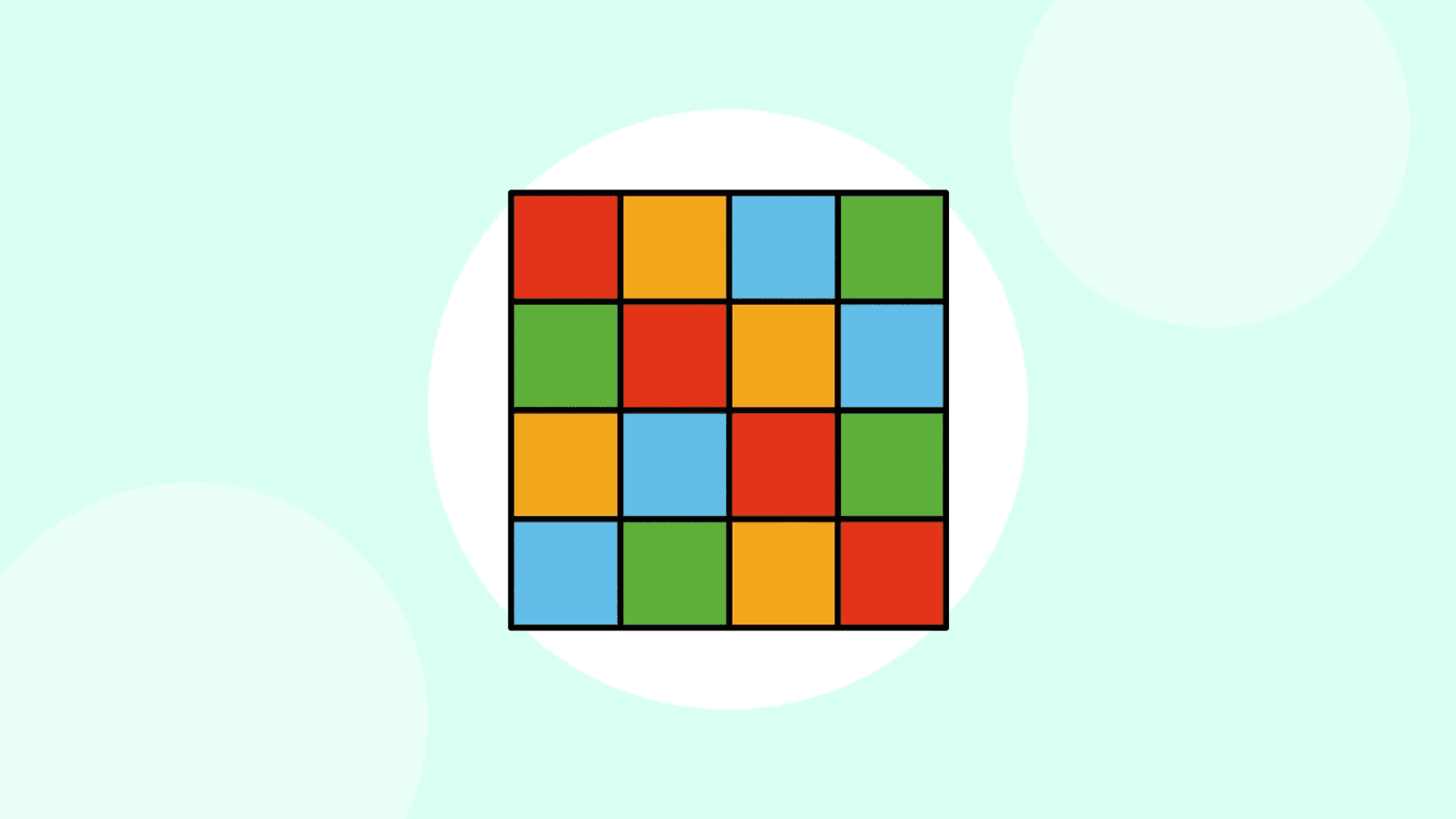

How many cells per page, where to put the words, should they be coloured? Grid size is chosen according to the person’s motor skills, vision and language, not their age. Once placed, words don’t move again, and colours remain a visual support, not a method.
How many cells per page?
The number, size and spacing of cells are decided after an assessment, not from a standard template (Beukelman and Light, 2020). Observe:
- Motor skills: can the person touch a small target without touching the one next to it? Put frequent words on the side where their hand is most accurate.
- Vision: cerebral visual impairment (CVI) often calls for fewer items, saturated colours and a dark background. Loss of visual field may require empty areas.
- Visual search: a dense grid of cells that all look alike slows searching down.
- Language: someone who combines words needs many words they can reach quickly; a beginner can start with very few.
- The device: a phone goes everywhere, but its screen may be too small. An ordinary consumer tablet has a social advantage: it looks like everyone else’s (Rummel-Hudson, 2011).
As a guide: some people manage only 2 to 4 items at a time, others use 50 to 75 cells (Beukelman and Light, 2020). As far as we know, no study compares 24, 48 and 80 cells: the choice is made by trial (see Choosing an AAC tool). Switch or eye gaze: see Access: positioning, switches, eye gaze.
More cells or more pages?
Few cells per page means bigger targets but more page changes, and every level of navigation costs time and attention. Many cells means more words in a single movement, but smaller targets and a more demanding search. Yet aided communication is typically 15 to 25 times slower than speech (Beukelman and Light, 2020): every keystroke saved counts.
Essential 24, Springboard 48, Horizon 80: three sizes
The vocabularies designed by Pictalk come in three sizes, conceived as a progression and described in detail on their overview page. Each one keeps a frame of safety words that is always visible.

| Essential 24 | Springboard 48 | Horizon 80 | |
|---|---|---|---|
| Grid | 4 × 6 | 8 × 6 | 10 × 8 |
| Device | Phone (portrait or landscape) | Tablet (landscape) | Tablet (landscape) |
| Who for | Beginners, or phone users | About 4 to 18 years, first word combinations | About 5 to 18 years, confident communicators |
| Frame always visible | yes, no, more, all done, help me, stop | yes, no, wait, help me, stop, something’s wrong | yes, no, I don’t know, not, more, all done, wait, help me, it hurts, stop |
| Home page | 9 frequent words and 9 links | 28 core words | 46 core words and 10 sentence starters |
Essential 24 also serves as a phone backup for tablet users; Horizon 80 adds a full QWERTY keyboard. These vocabularies follow published principles. Buddy also offers vocabularies designed for motor planning, Quick Core and Vocal Flair, in 24, 40, 60, 84 and 112 cells.
Starting small without reorganising everything
Going from 4 cells to 9, then to 16, means relearning everything at each step. It is better to start from the final grid and fill it in gradually: a few symbols in small groups separated by white space, then you fill the gaps without moving anything. This layout has helped people with Down syndrome (Wilkinson et al., 2017). In Pictalk’s vocabularies, hidden cells are revealed as the person progresses. For someone who manages very few items, Buddy lets you create grids from 1 × 1 to 30 × 30 cells (see Making a communication board).
Why words should never move
You find the hall light switch in the dark: your hand knows the way. That is motor planning. When each word keeps its place, the movement becomes automatic and attention goes to the conversation (Beukelman and Light, 2020). Stability also helps the people around the person: adults who model on a child’s device often find words slowly (von Tetzchner, 2018). A fixed layout is learnt once and for all (see Model, wait, respond).
LAMP, Unity: what does the research say?
LAMP (Language Acquisition through Motor Planning) teaches words through repeated movements on a fixed layout. Unity (based on Minspeak) combines icons with several meanings: few keys, but codes that are hard for young children (Light and Lindsay, 1992; Light et al., 2004). Two levels of evidence need to be told apart:
- The LAMP programme rests on preliminary data: in a descriptive study, autistic children learnt 9 to 35 words in 8 weeks (Bedwani, Bruck and Costley, 2015). Without a controlled study, nothing shows that it does better than another approach.
- The principle of stable positions is widely agreed on: never move a learnt word, leave room to grow (Wilkinson et al., 2017; Light, Wilkinson et al., 2019).
Remembering a movement is not learning a word, which is learnt by seeing it used in context. Pragmatic organisation, for its part, repeats words on several pages to reduce navigation (see Beyond requests). No approach has been rigorously compared with the others.
What makes words move without anyone deciding to
- Adding or deleting a word and shifting the others: leave empty cells, hide instead of deleting.
- The same word in different places: ‘more’ top left on the Eating page, bottom right on the Play page, and the hand learns nothing.
- Automatic sorting, alphabetical or by frequency.
- ‘Bringing a word closer’ to help: this wipes out the learnt path.
- A paper board organised differently from the tablet.
If an organisation really doesn’t suit, change early and all at once, rather than by small moves.
In Pictalk’s vocabularies
Each core word keeps its cell on every page, and a checking tool rejects any page where it would have moved: ‘I’ and ‘want’ are in the same cells on the Essential 24 home page and on its Eating page. Cells such as [my name] are filled in where they are. In Buddy, everything can still be edited: it is up to the team not to reorganise.
To build automatic movements, show the full path (open the page, then touch the word) and let the person make the movement, even slowly.
When to move up a size?
The signal: the person looks for words that aren’t there. They ask for the keyboard or take long detours between pages.
Be careful: the three vocabularies share the same logic (safety frame, pronouns on the left, sentence starters, colours), but were designed separately, and words change place from one size to another. ‘I’ and ‘want’ open the top row in Essential 24 and Springboard 48; in Horizon 80, ‘what’ comes first and they move one cell to the right. The same goes for Essential 24 in portrait and landscape: choose one orientation and stick to it.
Changing size means relearning some of the paths: not at the same time as a change of school or home, with plenty of modelling, and judging over several weeks (Beukelman and Light, 2020). Respecting the person’s preference can speed up learning (van der Meer et al., 2011).
The Fitzgerald colour code: what are colours for?
Yellow for people, green for verbs, orange for nouns: this Fitzgerald colour code makes grammar visible, but according to the available studies it doesn’t help people find words faster.
The teacher Edith Fitzgerald described it in 1926 for deaf pupils: words are arranged by their role, in the order who → does what → how → what → where → when. AAC took from it a left-to-right organisation and several colour variants, with no single standard: check the key of each vocabulary. This organisation remains abstract for beginners (Beukelman and Light, 2020).
The colours of Pictalk’s vocabularies
| Word type | Colour | Examples |
|---|---|---|
| Pronouns | Yellow | I, you, he, me |
| Verbs | Green | go, eat, want |
| Nouns | Orange | apple, school, mom |
| Adjectives | Blue | big, little, happy |
| Adverbs | Brown | fast, now |
| Determiners and numbers | Grey | the, a, my, 2 |
| Interjections and social phrases | Pink | yes, hello, thanks |
| Little linking words | White | to, of, with, and |
| Negation | Light red | no, not, never |
The border of a button that opens a page takes that page’s colour: you can tell at a glance a word (which speaks) from a link (which opens a page).

What the research says
- Grouping symbols with the same internal colour (red foods together) speeds up searching in people with a developmental disability (Wilkinson and colleagues).
- Colouring the background by word type did not speed up searching in typically developing children (Thistle and Wilkinson, 2009, 2017), and the effect has not been tested with AAC users.
Use colour for contrast, without relying on it: stable positions help far more.
How to use them
These uses come from practice, not from studies:
- Making grammar visible when modelling: ‘I’ (yellow), ‘want’ (green), ‘apple’ (orange).
- Helping the people around the person: look for a verb among the green cells.
- Spotting an unbalanced page: an all-orange page has only nouns, no verb and no negation.
- Making negation stand out, so the person can refuse.
Precautions: don’t teach the colours as a lesson; always keep the symbol and the written word, especially for colour-blind people; with CVI, busy pastel backgrounds can get in the way; on a dense grid, colours quickly overload the page. In Buddy, the colour scheme can be set to ‘None’ and its intensity adjusted.
Frequently asked questions
What grid size for a child who is just starting?
Often a compact grid such as Essential 24, completed with their personal words (see Which words to put in the tool). But it is their motor skills, vision and interests that decide, not their age.
Can you keep the same vocabulary on a phone and a tablet?
Yes, Buddy syncs vocabularies between devices. On a phone, the same grid will be smaller: check that the cells are still easy to touch.
Pictalk Buddy brings together AAC boards, a visual schedule, guided sequences and notebooks, with the same symbols, on Android, iOS, the web and the watch. A pay-what-you-want app, developed by a non-profit association. Discover Buddy
Sources
- Beukelman, D. R., & Light, J. C., 2020, Augmentative & Alternative Communication (5th ed.), Paul H. Brookes.
- Cited from Beukelman & Light (2020): Fitzgerald (1926, Straight Language for the Deaf); Rummel-Hudson (2011); Wilkinson et al. (2017); von Tetzchner (2018); Light & Lindsay (1992); Light et al. (2004); Bedwani, Bruck & Costley (2015); Light, Wilkinson et al. (2019); van der Meer et al. (2011); Thistle & Wilkinson (2009, 2017).