
Your child uses PECS and you are wondering whether to move to robust AAC, with a rich vocabulary on a tablet? The two approaches do not have the same goal: PECS is very good at teaching requesting, robust AAC aims to let the person say anything. You can move from one to the other without taking anything away from the person.
What is PECS?
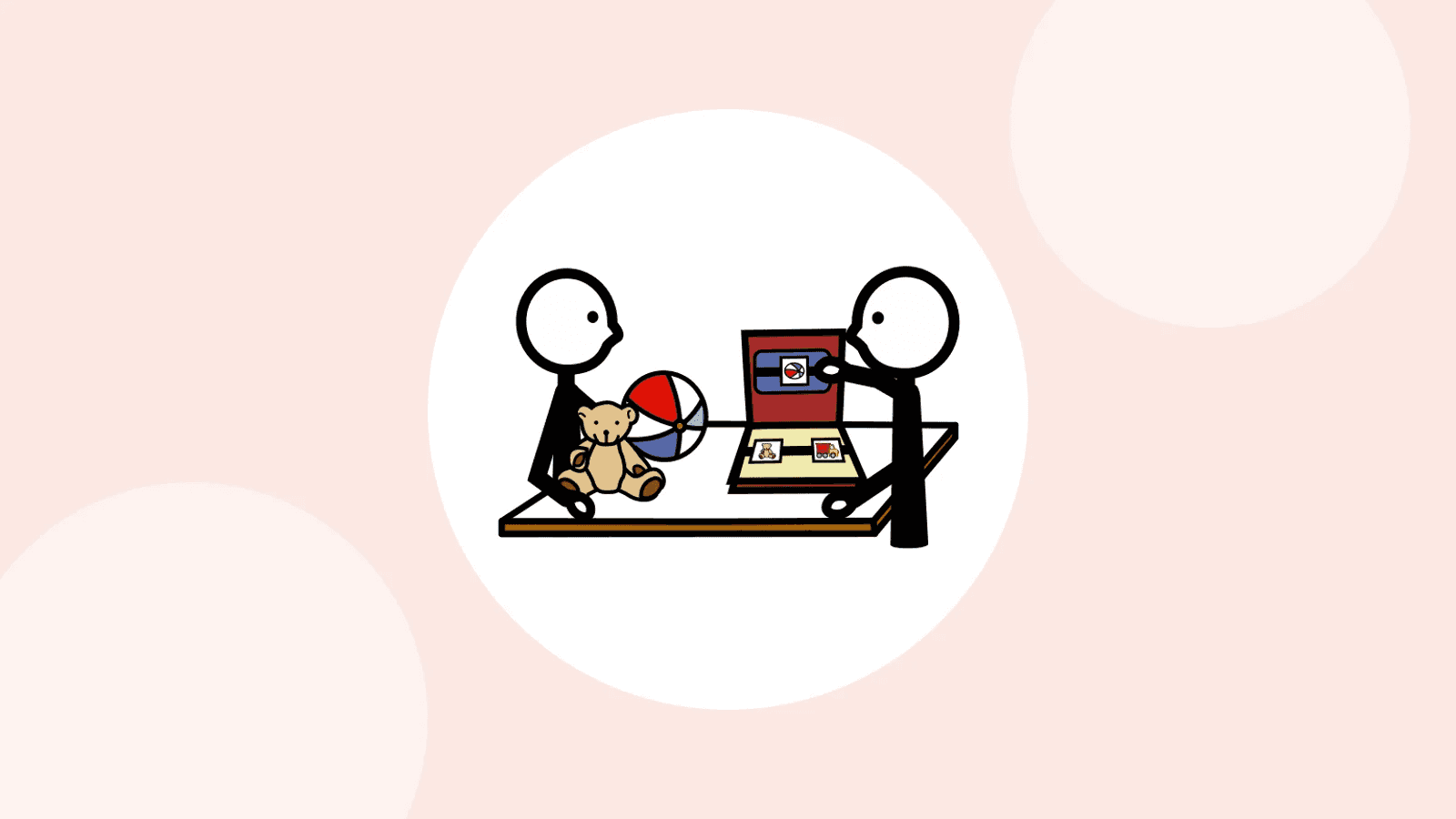
PECS (Picture Exchange Communication System) was developed in the United States in 1985 by Andy Bondy and Lori Frost, in a public programme for autistic pupils in Delaware. The principle: the person gives a picture to their communication partner to get what they want. The exchange makes the intention to communicate very visible, and it requires going to someone.
The method follows six phases, simplified here:
- exchanging a picture for a wanted item;
- fetching their book and their partner, even at a distance;
- choosing the right picture among several;
- building a simple sentence (‘I want’ + item);
- answering the question ‘What do you want?’;
- commenting (‘I see’, ‘I hear’).
PECS is a highly structured form of AAC. A meta-analysis finds moderate to strong evidence for learning to request, but little evidence for commenting (Ganz et al., 2012, cited in Beukelman & Light, 2020). Being able to ask reduces frustration, but we also communicate to comment, refuse, ask questions, tell stories. As a parent quoted by Beukelman and Light put it: there’s more to life than cookies. See Beyond requests.
What do we mean by robust AAC?
The term spread through clinical practice, without a single research-based definition. A system is called robust when, in time, it lets the person say more or less anything they want, and when it grows with them:
- a large vocabulary: core words for combining (‘more’, ‘all done’, ‘go’, ‘not’) and personal words;
- every communicative function: requesting, refusing, commenting, asking questions, telling stories, joking, saying something is wrong;
- stable positions, so that movements become automatic (see Organising the grid);
- a path towards grammar: verb forms, endings, little words;
- access to letters, the only truly open vocabulary;
- availability at all times, at home, at school, out and about.

Robust does not mean complicated from day one: you can start with a few visible buttons and reveal the others over time, without ever moving a word that has been learnt.
PECS and robust AAC: the differences
| PECS | Robust AAC | |
|---|---|---|
| Main goal | Starting a request towards a partner | Communicating for every reason |
| Tool | Book of pictures to exchange | Tablet, book with fixed positions, or both |
| Vocabulary | Mostly names of wanted items | Core words, personal words, ready-made phrases, letters |
| Learning | Phased protocol, with prompts | Modelling in real situations, opportunities, waiting |
| Voice | No, except in digital versions | Yes, on a tablet |
On the research side, modelling, at the heart of robust AAC, is one of the best-supported strategies (see Model, wait, respond). Other principles, such as motor planning or organisation into ready-made phrases, have so far been little studied.
When does PECS make sense?
- for a person who does not yet approach others to communicate;
- when the physical exchange helps them understand that a message is addressed to someone;
- when the team is trained in the protocol and applies it everywhere.
Nothing stops you modelling on a richer tool at the same time: the two can coexist.
How do you move from PECS to robust AAC?
- Keep what works. Familiar pictures, the habit of going to someone and the requests already learnt remain points of support.
- Use the same symbols at first, so nothing has to be relearnt.
- First add words that are not nouns: ‘more’, ‘all done’, ‘stop’, ‘help’, ‘not that’.
- Model a lot, without demanding anything at first.
- Vary the requests. Not all of them start with ‘I want’; first combinations often drop the ‘I’.
- Give words for commenting and refusing: ‘yuck’, ‘awesome’, ‘oh no’, ‘not now’.
- Allow time. A new tool is judged over several weeks, in real routines.
 Keep what worksFamiliar pictures and the habit of going to someone
 Add wordsTo combine, comment and refuse
 ModelA lot, without demanding anything at first
 Allow timeSeveral weeks, in real routines
To choose the tool (paper or tablet) and organise a trial, see Choosing an AAC tool. In Pictalk Buddy, the PicTalk Essential 24, Springboard 48 and Horizon 80 vocabularies keep words in fixed positions and offer an ‘I want + word’ carrier phrase, close to phase 4 of PECS. Printable materials are available on the resources page.
Frequently asked questions
Do you have to finish the six phases of PECS before moving to a tablet?
No: there are no prerequisites for AAC. You can introduce a richer tool at any time and model it alongside (see Myths about AAC).
My child can ask for things with PECS: why change?
There is no question of taking away what they know. The aim is to add words for commenting, refusing, asking questions and telling stories.
Will a talking tablet stop my child from speaking?
No: AAC does not prevent speech from developing. What the studies say is set out in AAC and speech.
Pictalk Buddy brings together AAC boards, a visual schedule, guided sequences and notebooks, with the same symbols, on Android, iOS, the web and the watch. A pay-what-you-want app, developed by a non-profit association. Discover Buddy
Sources
- Beukelman, D. R., & Light, J. C., 2020, Augmentative & Alternative Communication (5th ed.), Paul H. Brookes.
- Study cited from Beukelman & Light (2020): Ganz et al. (2012).
- Bondy, A., & Frost, L., 1994, The Picture Exchange Communication System, Focus on Autistic Behavior, 9(3), 1-19.