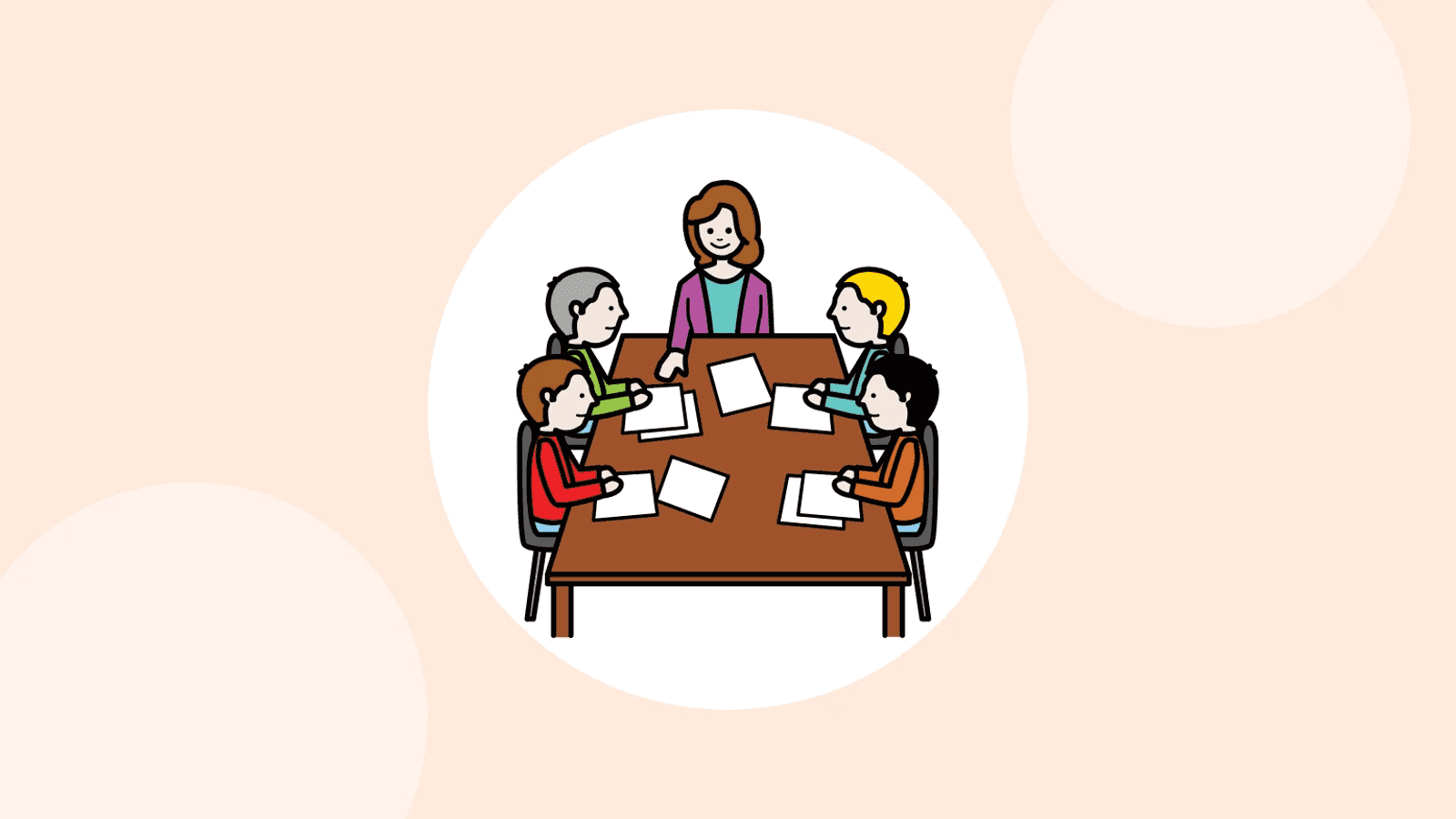

Setting up AAC isn’t just about choosing an app: it means understanding how the person takes part in their life, giving them a way to communicate straight away, then organising a team that keeps the tool alive wherever they live. A team that works well often does more for communication than the best tool.
 AssessParticipation, with several informants
 TryA way to communicate from the assessment onwards, adjusted session by session
 Keep it goingAn AAC lead, trained partners, reviewed goals
Do you have to wait for the end of the assessment to offer a tool?
No. No age, cognitive level or diagnosis is a condition for access to AAC, and working on so-called ‘prerequisite’ skills in isolation does not improve communication (Kangas and Lloyd, 1988; Romski and Sevcik, 1988). Offer a way to communicate during the assessment, then adjust it session by session. From the first appointment, also tell families that AAC does not hold back speech: see AAC and speech and Myths about AAC.
Assess participation, not just the person
The Participation Model (Beukelman and Mirenda), adopted by ASHA, works as a loop:
- Describe the participation of the person in their activities and their communication needs, compared with that of their peers.
- Identify the barriers, of two kinds: opportunity barriers (policies, practices, knowledge, skills or attitudes of the people around them) and access barriers (linked to the person’s abilities).
- Choose the interventions: create opportunities, build on natural abilities, adapt the environment, provide AAC.
- Plan for today and for tomorrow, by training the person and their partners.
- Assess participation, then start again.
This framework stops the assessment being reduced to the individual’s abilities: many of the barriers are in the environment.
Gathering communication needs
One grid per situation
The communication needs assessment (Beukelman et al., 1985) rates each need as essential, desirable, not important or future need. It reviews:
- messages: calling for attention, emergencies, yes/no, requests, conversation, feelings, medical needs…;
- modes: spoken, written, telephone, private;
- partners: people who can’t read, strangers, groups, people who are hard of hearing;
- places: noisy, outdoors, in the car;
- positions: in bed, walking, lying down.
Several informants
Asked separately, parents, speech and language therapists and teachers each suggest words the others haven’t mentioned (Morrow et al., 1993). The person themselves remains the first source, and has the last word. The Social Networks inventory (Blackstone and Hunt Berg, 2003), which maps five circles of partners, often reveals that only family and paid professionals are still around.
Supporting tools
For early communication, the Communication Matrix (Rowland, 2004) or the CSBS (Wetherby and Prizant, 1993) help to identify the stage. Inventories such as the MacArthur-Bates CDI give a map of first words, to be trimmed because informants often tick too many. Also assess understanding with and without visual support: some people understand much better when speech comes with writing or pictures (Light et al., 1998).
Assess without relying on a single test
- Observe over several days, in several places and with several partners. Avoid making any prognosis.
- Prefer dynamic assessment (teach, then test) and functional criteria to modified standardised tests.
- Test symbols rigorously: a yes/no answer has a one-in-two chance of being right by chance; vary the position of the targets, watch for position preferences and deliberately choose distractors that are visually or semantically close.
- Test all types of words, not just nouns: actions, questions, social words. Abstract words will be less successful: that’s a reason to teach them, not to remove them.
- Assess access starting with direct selection: hand, then eyes, then head, then foot. Positioning, switches and eye gaze are covered in Access: positioning, switches, eye gaze.
Choosing the first system
Sum up the assessment as a list of requirements and compare systems against that list, rather than against the software you know best or feature comparison charts, which have never been validated and are often biased towards the most high-tech solutions (Beukelman and Light, 2020): the criteria checklist and the trial protocol are in Choosing a tool: paper, tablet, trial.
Who does what in the team?
Partners are half the system: those who model, give time and respond to every attempt get significant progress (Kent-Walsh et al., 2015; O’Neill, Light and Pope, 2018).
| Member | What they bring |
|---|---|
| The person themselves | Their tastes, their priorities, their views on the words and the tool. They have the last word on what represents them. |
| Parents and family | Close knowledge of the person, personal words, routines, continuity over time. |
| Speech and language therapist | Assessment, choosing and personalising the system, language goals, training partners. |
| Occupational therapist | Access (cell size, position and mounting of the tablet) and seating. Good positioning improves accuracy (Costigan and Light, 2010). |
| Teacher, teaching assistant | School vocabulary, opportunities to communicate in class and with classmates. |
| Support workers, psychologist | Daily life in a specialist setting or support service, emotional regulation, behaviours that hide a message. |
| Doctor | Prescriptions, referrals, medical evidence for support and funding applications, adapting care. |
| Brothers and sisters, classmates, friends | Natural and motivating partners, often excellent at modelling. |
One last possible member is often forgotten: an adult who uses AAC themselves. Mentoring by experienced people helps both the mentor and the person being mentored (Beukelman and Light, 2020).
Name an AAC lead
When everyone thinks someone else is updating the tool, nothing moves for months. Name one person responsible, day to day, for:
- adding new words and removing those no longer used;
- checking that the device is charged and that the paper backup is up to date;
- introducing the tool to new partners (supply staff, new colleagues, students on placement);
- training the person who will take over if they leave.
In specialist settings, this role is part of a setting-wide AAC plan: see AAC in specialist settings.
Agree on the essentials
These points must be shared by every place where the person lives:
- The same tool, with the same layout. If the words aren’t in the same place at home and at school, the person has to relearn everything. See Organising the grid: size, fixed positions and colours.
- The same yes / no signal, known to everyone and written down.
- A communication dictionary: the person’s own gestures, sounds or reactions, what they mean and how to respond, displayed where they live. See Being understood.
- Shared goals: which skill, with whom, in which situations, and how you will know it has been learnt.
- Who adds which words, and when: for example, the teacher passes on the list for the next topic, the family adds the weekend’s words.
- A plan B: an identical paper board for outings, bath time, breakdowns.
Train partners, a little and often
Less than five hours of training is enough to change practice, and ‘just in time’ sessions of 15 to 20 minutes have a measurable effect (Kent-Walsh and Binger, 2013; Holyfield et al., 2018). Parents prefer several short sessions, of about an hour, to one long day (Meder and Wegner, 2015). A simple method (Kent-Walsh and McNaughton, 2005):
- describe the strategy (for example, waiting 5 to 10 seconds);
- demonstrate it in a real situation;
- ask the partner to put it in their own words;
- practise with immediate feedback;
- apply it in real life, with support that fades;
- plan how to keep it going in new situations.
In one study, remote training by screen sharing did as well as face-to-face training (Quinn et al., 2011): useful when the speech and language therapist and the school are far apart. The strategies to pass on: Model, wait, respond.
Share information without adding to the workload
- At school, the review meetings for the pupil’s support plan are the natural place to take stock of AAC and write it into the plan: see AAC at school.
- Day to day, a visual home-school diary or a digital life book lets the person tell people about their day from one place to the next.
Getting transitions right: class, setting, adulthood
A new class, starting at a setting, moving house, moving to adult services: this is where the thread is most often lost. One person with a brain injury lived in eleven places in fifteen years, and losing trained support staff was the main reason they gave up their AAC (Fager et al., cited in Beukelman and Light, 2020). A few rules:
- visit the new place in advance and spot the words that will be missing;
- don’t change tool at the same time as changing place;
- prepare a handover file: the vocabulary, the ‘How to talk to me’ card, the communication dictionary, the access settings;
- organise a short training session for the new team.
In adolescence and adulthood, the person must stay in control of their profile and of what is shared: ask for their agreement before passing on their messages or notebooks. For adult life, see Adolescence and adulthood.
Track progress and keep the tool alive
Write measurable goals that specify the skill, the means, the partners, the places and the criterion. Goal attainment scaling (GAS), scored from −2 to +2 and reviewed about every three months, lets you track progress. Also review at every transition and every change in health.
The most common reasons for abandoning AAC are almost always shared ones: a poorly suited tool, vocabulary never updated, untrained partners, a relative’s refusal, losing support staff when changing services. Each has its answer in this guide: going back to the needs gathered, an AAC lead, short training for newcomers, a handover file.
Frequently asked questions
Who should lead the AAC team?
Often the speech and language therapist, but that’s not a rule. What matters is that the AAC lead is clearly named.
Should all the professionals use the same app?
For the person, one system with the same layout everywhere. Professionals can work with other software on their side: an open exchange format such as OBZ, which Pictalk Buddy imports and exports, makes it possible to share boards.
What if the family and the school disagree?
Go back to two questions: what helps the person take part more, and what do they think? Respecting their preferences can speed up learning (van der Meer et al., 2011), and communication remains a right: see What is AAC?.
Pictalk Buddy brings together AAC boards, a visual schedule, guided sequences and notebooks, with the same symbols, on Android, iOS, the web and the watch. A pay-what-you-want app, developed by a non-profit association. Discover Buddy
Sources
- Beukelman, D. R. & Light, J. C. (2020). Augmentative & Alternative Communication (5th ed.). Brookes, ch. 2, 3, 4, 8, 11, 17.
- Studies cited from this book: Kangas & Lloyd, 1988; Romski & Sevcik, 1988; Beukelman et al., 1985; Morrow et al., 1993; Blackstone & Hunt Berg, 2003; Rowland, 2004; Wetherby & Prizant, 1993; Light et al., 1998; Kent-Walsh et al., 2015; O’Neill, Light & Pope, 2018; Costigan & Light, 2010; Kent-Walsh & Binger, 2013; Holyfield et al., 2018; Meder & Wegner, 2015; Kent-Walsh & McNaughton, 2005; Quinn et al., 2011; Fager et al.; van der Meer et al., 2011.