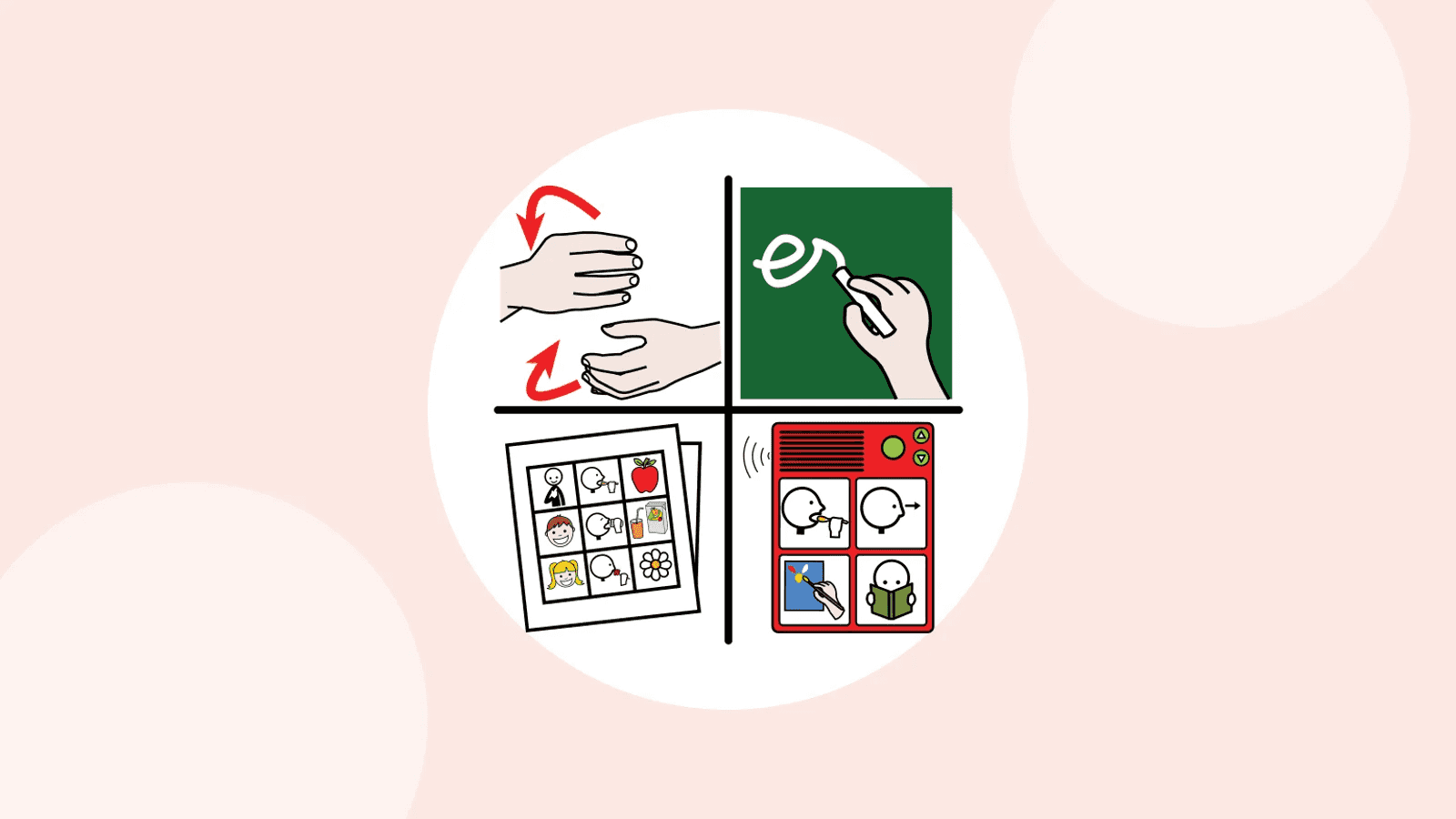
Augmentative and alternative communication (AAC) covers every way of adding to or replacing speech: gestures, signs, symbols, communication boards, speaking apps, writing. It is for anyone whose speech is not enough to be understood in daily life, at any age and with no prerequisites. Here are the basics, then the guides to read depending on whether you are a parent or a professional.
What exactly is AAC?
AAC means all the ways of adding to or replacing speech and writing, from gestures to speaking apps. It is not a single tool or a single method: signs, a symbol book or a talking tablet are all AAC.
We talk about complex communication needs when a person’s speech does not meet their everyday communication needs, whatever the cause. This includes, for example:
- children who do not talk yet or talk very little, with or without a diagnosis (my child isn’t talking);
- autistic people (autism and AAC);
- people with Down syndrome (Down syndrome and AAC);
- people with cerebral palsy or profound and multiple disabilities (access: positioning, switches, eye gaze);
- people who speak a little but have difficulty making themselves understood or whose communication is ineffective, for example with childhood apraxia of speech (AAC and speech);
- adults who lose their speech after a stroke (aphasia) or with motor neurone disease (AAC for adults).
‘But we understand him perfectly well’
Many families understand their child’s gestures, sounds and looks. That is precious, but it is partly an illusion of communication: at school, at the doctor’s or in a shop, people do not know the child as closely, do not know their life and often misunderstand them. AAC is about being understood by everyone, not only by those who have learnt to guess. A ‘How to talk to me’ card helps to prepare these encounters.
Alternative or augmentative: what is the difference?
The two words in the name describe two uses that complement each other.
| Alternative communication | Augmentative communication | |
|---|---|---|
| Role | Replaces speech when it is absent or unusable | Adds to speech that exists but is not enough |
| Who for | People who do not speak | People who speak a little, or who are hard to understand |
| Example | Building a sentence on an app that says it aloud | Saying a word and showing the symbol when the listener has not understood |
‘Augmentative’ means adding: new means are added to those that already exist. The line is not fixed: the same tool can replace speech for one person and add to it for another.
Aided or unaided AAC: with or without a tool?
The second distinction is about the means used.
| Type | Principle | Examples |
|---|---|---|
| Unaided | The body alone, with no external tool | Gestures, signs, facial expressions; key word signing such as Makaton; British Sign Language (BSL) |
| Aided, low-tech | A tool with no electronics | Communication board, symbol book, alphabet board, paper visual schedule |
| Aided, high-tech | An electronic tool | Tablet or phone with an AAC app, speech-generating device |
Unaided AAC is always available, but only people who know the signs understand it (with key word signing, you say the whole sentence and sign only the important words). Aided AAC means having your tool with you, but anyone can understand it: a synthetic voice can be heard from a distance, including by people who cannot read.
Paper and digital complement each other, and a paper backup remains essential when the device is not available. To compare the options and organise a trial, read choosing a tool: paper, tablet, trial.
Symbols, methods, apps: a few landmarks
- Symbols are simplified drawings that stand for a word or an idea; the free ARASAAC library is one widely used source.
- PECS is an AAC method based on exchanging pictures, mainly used to teach requesting (PECS or robust AAC?).
- PODD, designed by Gayle Porter, organises pages by intention (chatting, asking a question, saying something is wrong) rather than by word category (beyond requests).
- AAC apps are reviewed in the AAC app comparison.
Technical terms (scanning, core vocabulary, motor planning…) are explained in the AAC glossary.
Why do we talk about multimodal communication?
Nobody communicates in only one way: we talk, but we also point, shrug, write a note. A person who uses AAC does the same: they mix speech, vocalisations, gestures, paper and device, depending on who they are with and the situation. A single mode is never enough (Williams, Krezman and McNaughton, 2008, cited in Beukelman and Light, 2020).
 Speech and soundsA sound that is understood is a successful message
 Gestures and signsFor a simple request with someone close
 Paper boardTakes over when the device is not there
 AppTo tell a story, or to talk to someone who does not know the signs
A sign is often enough for a simple request with someone close; the app is for telling stories or talking to someone who does not know the signs; paper takes over when the device is not there. So the aim is not to replace one means with another, but to add more. A gesture or a sound that is understood is a successful message: respond to it, whatever the channel.
Communication is a right
Communication is a fundamental human right, yet it is often neglected for lack of time, training or tools that are easy to set up. Access to communication comes before independence and learning, and it is essential to well-being and mental health: many behaviours that challenge come from not having the means to express themselves. Specialist settings, too, need to plan for AAC (AAC in specialist settings).
Which principles should you know before you start?
These principles sum up the research consensus, as synthesised by Beukelman and Light (2020). Each one is covered in its own guide.
- There are no prerequisites: nobody is too young, too old or ‘not ready’, and training so-called prerequisite skills in isolation does not improve communication (Kangas and Lloyd, 1988; Romski and Sevcik, 1988), as explained in myths about AAC.
- Presuming competence means starting from the idea that the person understands more than they can express (myths about AAC).
- AAC does not stop speech: it does not hold speech back and often helps it develop (Millar, Light and Schlosser, 2006; Romski et al., 2010), as detailed in AAC and speech.
- AAC is learnt by seeing it used: pointing to symbols on the person’s own tool while you talk to them (modelling) has large effects on understanding and expression according to several meta-analyses (Allen et al., 2017; O’Neill, Light and Pope, 2018), see model, wait, respond.
- The people around matter as much as the tool: a language that is not used to communicate with family ends up abandoned, and the commitment of professionals alone is not enough (training communication partners).
- Communicating is more than requesting: sharing news, greeting, joking or telling a story matter as much as expressing needs (Light, 1988), see beyond requests.
- Personal words matter as much as core words: a beginner starts with their own words (names, foods, games) and a few powerful words such as ‘more’, ‘all done’ or ‘help’ (Laubscher and Light, 2018), see which words to put in the tool.
- Vocabulary is never finished: vocabulary that is not updated is one of the main reasons tools are abandoned (Johnson et al., 2006), hence the importance of keeping the tool’s words up to date.
- Words don’t move: when each word always keeps the same place, the movement to reach it becomes automatic, see organising the grid.
- AAC also helps understanding: visual schedules work at any age (Bopp et al., 2004; Knight et al., 2015), see visual supports: schedule, sequences, timer.
- Reading and writing are a goal for everyone: writing is the only way to an unlimited vocabulary, and it can be taught with no prerequisites, see AAC and literacy.
Where should you start?
Follow the path that fits you, in order. If the person’s situation is known (autism, Down syndrome, aphasia…), add the matching guide listed above.
You are a parent
- My child isn’t talking: where to start: milestones, warning signs, first steps at home.
- Myths about AAC: ‘too young’, ‘not ready’… what the research says.
- AAC and speech: even if your child already says a few words.
- Model, wait, respond: how to talk with the tool every day.
- Which words to put in the tool: first words, core and personal.
- Visual supports: schedule, sequences, timer: helping your child understand their day.
- Choosing a tool: paper, tablet, trial: try before you decide.
- Funding AAC: how to prepare a funding request.
You are a professional
Speech and language therapist, educator, teacher or member of a care or support team:
- Setting up AAC as a team: assessment, AAC lead, teamwork.
- Model, wait, respond: modelling, wait time and partner training.
- Which words to put in the tool: core, fringe and personal vocabulary.
- Organising the grid: grid size, fixed positions and colour coding.
- Beyond requests: working on every communicative function.
- AAC and literacy: teaching reading and writing.
- AAC at school: support plans, teaching assistants and adapted learning materials.
- AAC in specialist settings: what a setting-wide AAC plan should cover.
Frequently asked questions
How long does it take to learn AAC?
AAC is learnt like a language, over years, but you can start today. Partners progress quickly: less than five hours of training is enough to change how they work (Kent-Walsh and Binger, 2013, cited in Beukelman and Light, 2020).
Who can support us?
A speech and language therapist can advise you and help you choose the right method and tool. Communication Matters, the UK chapter of ISAAC, provides information and brings together families and professionals.
Pictalk Buddy brings together AAC boards, a visual schedule, guided sequences and notebooks, with the same symbols, on Android, iOS, the web and the watch. A pay-what-you-want app, developed by a non-profit association. Discover Buddy
Sources
- Beukelman, D. R. and Light, J. C., 2020, Augmentative & Alternative Communication: Supporting Children and Adults with Complex Communication Needs, 5th ed., Paul H. Brookes.
- Studies cited from this book: Williams, Krezman and McNaughton (2008); Kangas and Lloyd (1988); Romski and Sevcik (1988); Millar, Light and Schlosser (2006); Romski et al. (2010); Allen et al. (2017); O’Neill, Light and Pope (2018); Light (1988); Laubscher and Light (2018); Johnson et al. (2006); Bopp et al. (2004); Knight et al. (2015); Kent-Walsh and Binger (2013).